
Janis Joplin’s vocal range spanned approximately F3 to C6 — about two and a half octaves. Her voice type was a mezzo-soprano, but her artistry had little to do with range width and everything to do with raw, emotional intensity. One of rock’s most distinctive voices, Joplin delivered blues-rooted power with a gritty, unrestrained passion that few have matched.
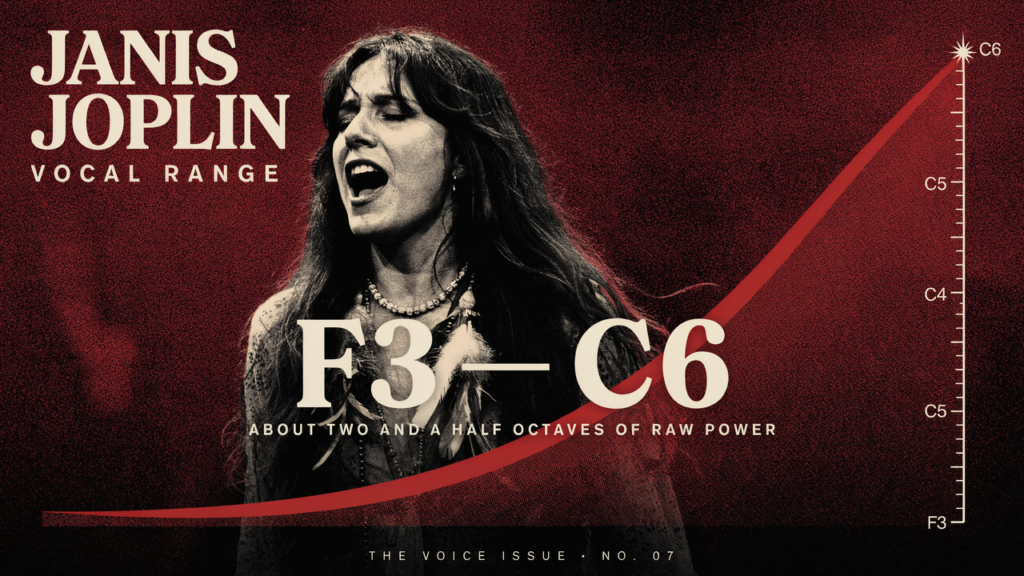
Janis Joplin Vocal Range at a Glance
| Detail | Value |
|---|---|
| Full Range | F3–C6 |
| Span | ~2.5 octaves |
| Voice Type | Mezzo-Soprano |
| Lowest Note | F3 |
| Highest Note | C6 |
| Tessitura | A3–E5 |
| Known For | Raw emotional intensity, blues grit, raspy power |
What Voice Type Was Janis Joplin?
Janis Joplin was a mezzo-soprano — the middle female voice type. But her singing style drew heavily on the low, gritty chest-voice power associated with blues singers, giving her voice an aggressive, raw quality unusual for the era.
Her technique prioritised raw emotional expression over polish, with a distinctive rasp and a willingness to push her voice to its limits. For more on how female voices are classified, see the female vocal range chart and mezzo-soprano vocal range guide.
What Makes Janis Joplin’s Voice Distinctive
Raw emotional intensity. Joplin’s defining quality was the sheer emotional commitment in her delivery — she sang with an unrestrained passion that made her performances feel raw and immediate.
Blues-rooted grit. Drawing on blues and soul traditions, her voice had a gravelly, powerful quality that conveyed pain, longing, and joy with equal force.
Dynamic extremes. She moved between tender, vulnerable passages and full-throated, screaming intensity, often within a single song.
Songs That Showcase Janis Joplin’s Range
“Piece of My Heart” (1968) — Her signature, showcasing her raw power and emotional intensity across dynamic extremes.
“Me and Bobby McGee” (1971) — Builds from gentle, conversational verses to a powerful, freewheeling climax.
“Cry Baby” (1971) — A blues showcase demonstrating her gritty power and emotional vulnerability.
“Summertime” (1968) — Her interpretation of the standard, highlighting her ability to blend tenderness with raw intensity.
“Ball and Chain” (1968) — A blues epic demonstrating her stamina, range, and emotional commitment.
How Janis Joplin’s Range Compares to the Average Singer
The average singer has a range of about 1.5–2 octaves. Joplin’s two-and-a-half-octave range was above average, but her impact had nothing to do with range width. Her example demonstrates that vocal greatness can come from raw emotional power and a distinctive voice rather than technical range.
Compare her range to other rock and blues voices with the singer comparison tool, or explore the full list of famous singer vocal ranges.
Frequently Asked Questions
What was Janis Joplin’s exact vocal range? Her range spanned approximately F3 to C6 — about two and a half octaves. Her tessitura sat between A3 and E5.
What voice type was Janis Joplin? Janis Joplin was a mezzo-soprano who sang in a low, gritty, blues-influenced chest-voice style.
How many octaves could Janis Joplin sing? Joplin had a usable range of approximately two and a half octaves, above the average singer.
What made Janis Joplin’s voice unique? Her raw emotional intensity, gritty blues-rooted power, and willingness to push her voice to its limits made her one of rock’s most distinctive and influential voices.
Who has a voice similar to Janis Joplin? Few singers match Joplin’s raw intensity, though blues-rock vocalists who prioritise emotional power over polish carry on her tradition.

Cooke is a vocal training and singing education writer specializing in vocal range analysis, pitch recognition, voice development, and singing tools for vocalists, performers, musicians, and beginners. He creates practical content focused on vocal improvement, singing techniques, and voice analysis resources.