
Cyndi Lauper’s vocal range spans approximately F3 to G6 — about four octaves. Her voice type is a soprano with remarkable versatility, capable of moving from a powerful belt to a delicate head voice, and from quirky pop to operatic-leaning passages. Often underestimated, Lauper is one of the most technically capable voices in pop music.
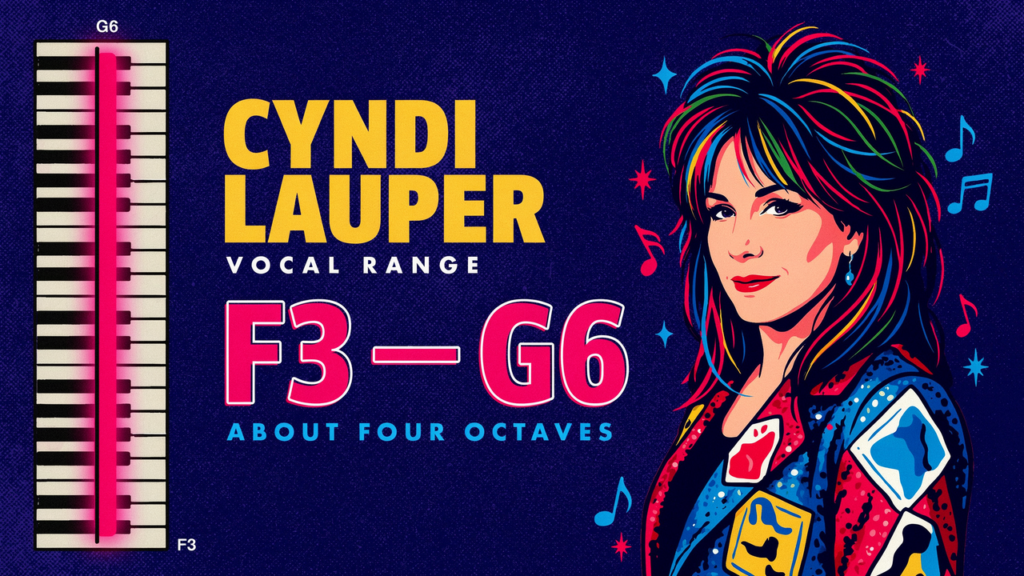
Cyndi Lauper Vocal Range at a Glance
| Detail | Value |
|---|---|
| Full Range | F3–G6 |
| Span | ~4 octaves |
| Voice Type | Soprano |
| Lowest Note | F3 |
| Highest Note | G6 |
| Tessitura | A3–E5 |
| Known For | Wide range, versatility, distinctive timbre, belting |
What Voice Type Is Cyndi Lauper?
Cyndi Lauper is a soprano with an exceptionally wide range and versatile technique. Her distinctive, sometimes quirky timbre can mask the genuine technical skill underneath — she can belt powerfully, float delicate head-voice notes, and access an unusually high upper register.
Her range and control reflect a serious vocal foundation, including training in operatic technique. For more on the soprano classification, see the soprano vocal range guide and the female vocal range chart.
What Makes Cyndi Lauper’s Voice Distinctive
Wide range and versatility. Lauper moves from powerful chest-voice belting to delicate head voice and into an unusually high upper register, all within her catalogue.
Distinctive timbre. Her voice has a unique, instantly recognisable character — quirky and expressive — that sets her apart from more conventional pop sopranos.
Technical capability. Beneath the playful pop persona is a technically skilled vocalist with operatic-leaning control, able to execute demanding passages cleanly.
Songs That Showcase Cyndi Lauper’s Range
“Time After Time” (1983) — A tender ballad showcasing her control and emotional warmth in the middle of her range.
“True Colors” (1986) — Demonstrates her dynamic range, building from intimate verses to a powerful, sustained climax.
“Girls Just Want to Have Fun” (1983) — Highlights her bright, energetic pop delivery and distinctive tone.
“All Through the Night” (1983) — Shows her control across soft, atmospheric passages.
“Money Changes Everything” (1983) — Demonstrates her belting power and upper-register intensity.
How Cyndi Lauper’s Range Compares to the Average Singer
The average singer has a range of about 1.5–2 octaves. Lauper’s four-octave range places her among the widest in pop — in 4-octave vocal range territory, achieved by very few singers. Her range often surprises listeners who know her primarily for her pop hits.
Compare her range to other wide-ranging voices with the singer comparison tool, or explore the full list of famous singer vocal ranges.
Frequently Asked Questions
What is Cyndi Lauper’s exact vocal range? Her range spans approximately F3 to G6 — about four octaves. Her tessitura sits between A3 and E5.
What voice type is Cyndi Lauper? Cyndi Lauper is a soprano with an exceptionally wide range and versatile, technically capable voice.
How many octaves can Cyndi Lauper sing? Lauper has a usable range of approximately four octaves, among the widest in pop music.
Is Cyndi Lauper a trained singer? Yes — beneath her playful pop persona is a technically skilled vocalist with operatic-leaning control and a serious vocal foundation.
Who has a voice similar to Cyndi Lauper? Few pop singers match Lauper’s combination of wide range and distinctive timbre, though other versatile sopranos like Kate Bush share some of her range and adventurousness.

Cooke is a vocal training and singing education writer specializing in vocal range analysis, pitch recognition, voice development, and singing tools for vocalists, performers, musicians, and beginners. He creates practical content focused on vocal improvement, singing techniques, and voice analysis resources.