
Dolly Parton’s vocal range spans approximately G2 to Eb6 — about three octaves. Her voice type is a soprano, characterised by a bright, clear tone with a distinctive vibrato and a light, agile quality. One of the most celebrated voices in country music, Parton combines technical skill with an instantly recognisable timbre and emotional warmth.
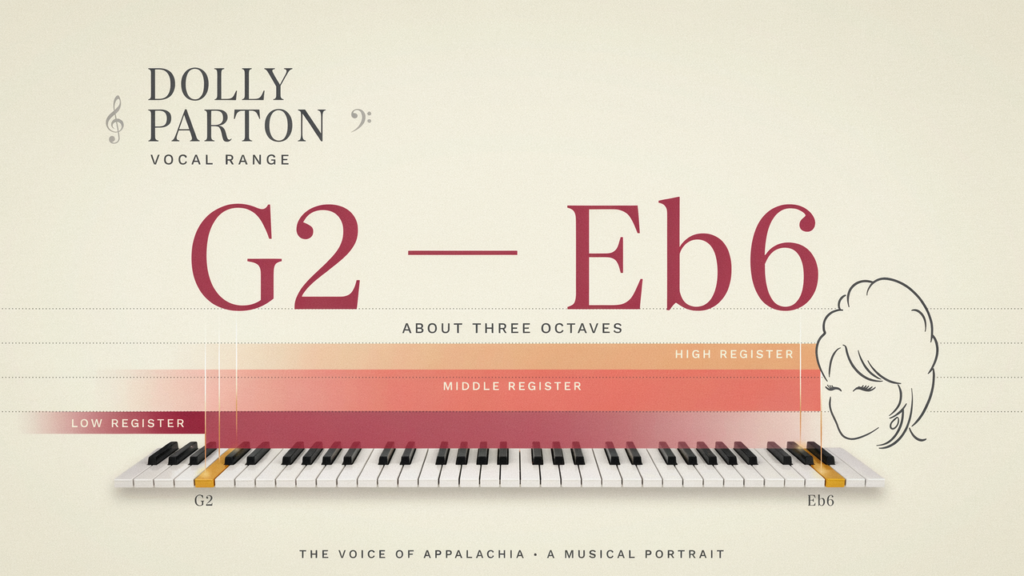
Dolly Parton Vocal Range at a Glance
| Detail | Value |
|---|---|
| Full Range | G2–Eb6 |
| Span | ~3 octaves |
| Voice Type | Soprano |
| Lowest Note | G2 |
| Highest Note | Eb6 |
| Tessitura | A3–D5 |
| Known For | Bright tone, distinctive vibrato, agility, emotional warmth |
What Voice Type Is Dolly Parton?
Dolly Parton is a soprano — a high female voice with a bright, clear tone. Her voice has a light, agile quality with a fast, distinctive vibrato that’s instantly recognisable. Despite the brightness of her upper register, she also has access to a surprisingly low chest voice, giving her unusual range for a country vocalist.
Her tone carries both technical polish and genuine emotional warmth, suited equally to upbeat country numbers and tender ballads. For more on the soprano classification, see the soprano vocal range guide and the female vocal range chart.
What Makes Dolly Parton’s Voice Distinctive
Distinctive vibrato. Parton’s fast, light vibrato is one of her signature features, giving her sustained notes a characteristic shimmer recognisable across decades of recordings.
Bright, agile tone. Her voice has a clarity and flexibility that suits both fast country numbers and delicate ballads, moving through melodic phrases with ease.
Emotional storytelling. Like the best country vocalists, Parton uses her voice to serve the story of each song, delivering emotional content with sincerity and warmth.
Songs That Showcase Dolly Parton’s Range
“I Will Always Love You” (1974) — Her original version of the song later made famous by Whitney Houston, showcasing her tender control and emotional delivery.
“Jolene” (1973) — Demonstrates her distinctive tone and the urgency in her mid-range delivery.
“9 to 5” (1980) — Highlights her bright, energetic upper register in an upbeat context.
“Coat of Many Colors” (1971) — A storytelling showcase highlighting her emotional warmth and phrasing.
“Here You Come Again” (1977) — Demonstrates her pop crossover appeal and vocal agility.
How Dolly Parton’s Range Compares to the Average Singer
The average singer has a range of about 1.5–2 octaves. Parton’s three-octave range places her well above average, in trained-professional territory. Her wide range — combining a low chest voice with a bright soprano top — is unusual for a country vocalist and adds to her versatility.
Compare her range to other country and pop voices with the singer comparison tool, or explore the full list of famous singer vocal ranges.
Frequently Asked Questions
What is Dolly Parton’s exact vocal range? Her range spans approximately G2 to Eb6 — about three octaves. Her tessitura sits between A3 and D5.
What voice type is Dolly Parton? Dolly Parton is a soprano with a bright, clear tone and a distinctive fast vibrato.
How many octaves can Dolly Parton sing? Parton has a usable range of approximately three octaves, well above the average singer.
What makes Dolly Parton’s voice recognisable? Her fast, light vibrato and bright, clear tone are her most distinctive features, recognisable across decades of recordings.
Did Dolly Parton write “I Will Always Love You”? Yes — Dolly Parton wrote and originally recorded “I Will Always Love You” in 1973. Whitney Houston’s 1992 cover later became a global hit.

Cooke is a vocal training and singing education writer specializing in vocal range analysis, pitch recognition, voice development, and singing tools for vocalists, performers, musicians, and beginners. He creates practical content focused on vocal improvement, singing techniques, and voice analysis resources.