
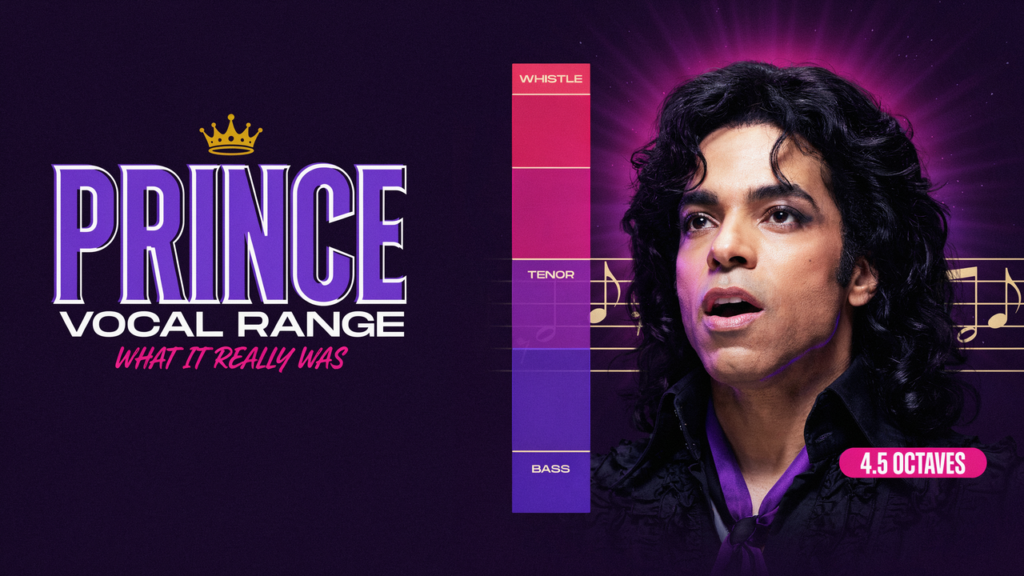
Prince’s vocal range spanned roughly from the low second octave (around E2) up to high falsetto notes in the sixth octave (around B6), giving him an estimated 3 to 4 octaves when including falsetto. He is generally classified as a tenor with exceptional upper-register control and a highly expressive falsetto.
That headline number sounds impressive. But the real story isn’t just how high he could go. It’s how he used his range.
Let’s break it down clearly and practically.
Understanding Prince’s Range in Context
Lowest and Highest Notes
In modal (full voice), Prince sang comfortably in the typical tenor zone. His lower notes dipped into the second octave, and his strongest singing lived in the third and fourth octaves.
His highest notes often appeared in falsetto — light, flexible, and controlled. That’s important. Falsetto is not the same as chest voice extension.
If you’re unsure how these registers differ, review this breakdown of chest voice vs head voice to understand where the power shifts.
Modal Range vs Falsetto Extension
Many octave claims online mix modal voice and falsetto together without explanation.
Here’s a clearer picture:
| Category | Approximate Range |
|---|---|
| Lowest Modal Notes | Around E2 |
| Strongest Singing Range | G3–E5 |
| High Modal/Mixed Notes | Up to around G5 |
| Falsetto Extension | Up to around B6 |
Falsetto extends range, but it does not mean the singer belts that high.
Was Prince a Tenor or Countertenor?
Prince is generally classified as a tenor.
A countertenor primarily sings in a reinforced falsetto range that overlaps with female mezzo-soprano territory. Prince used falsetto frequently, but his tessitura — the range where he was most comfortable and resonant — aligns more closely with tenor norms.
If you want clarity on where tenor sits, compare it to the standard tenor vocal range.
Why His Voice Sounded So High
Prince had:
- Strong upper mix coordination
- Efficient vocal fold closure
- Flexible falsetto control
- Excellent breath management
His tone stayed clear and focused even at high pitches. That makes a voice sound “higher” and more agile than it actually is in classification terms.
If you’re exploring your own placement, check your position against the average male vocal range for context.
What Made Prince’s Voice Unique
1. Dynamic Control
He could sing softly in falsetto and immediately switch to gritty chest voice. That contrast creates emotional impact.
2. Clean Upper Passaggio
The passaggio is where your voice shifts between registers. Prince navigated that transition smoothly. No obvious break. No strain.
If you’re not familiar with how tessitura differs from extremes, this guide on what is tessitura will help you avoid common misunderstandings.
3. Musical Use of Falsetto
His falsetto wasn’t weak or breathy. It had intention. That’s technique, not luck.
Can You Sing in Prince’s Range?
Before chasing high notes, measure your actual starting point. Use this method from how to find your vocal range so you know where you stand.
Range expansion is gradual. Trying to jump into sixth-octave territory without coordination is like sprinting before learning to walk.
Step-by-Step: Developing Upper Range Like Prince
This is not about copying tone. It’s about building coordination safely.
1. Stabilize Your Mid-Range
Your G3–E4 area should feel steady and supported. If your middle is unstable, your top will collapse.
2. Strengthen Breath Support
High notes need steady airflow. Not more air — steady air.
Work rib expansion and slow controlled exhalations. If support feels weak, revisit foundational breathing techniques for singers.
3. Train Mixed Voice Gradually
Use light “gee” or “nay” patterns ascending slowly. Stop before strain appears.
Think of it like climbing stairs — not jumping to the roof.
4. Build Falsetto Control
Falsetto should feel easy and released, not pushed. Practice sliding gently into upper notes instead of attacking them.
If you want structured drills, use exercises from vocal exercises to increase range.
5. Monitor Recovery
Your voice should feel normal the next day. If it’s raspy or fatigued, you’re pushing.
Recovery speed is your feedback system.
Common Mistakes When Trying to Sing Like Prince
Many singers misunderstand what they’re hearing.
- Shouting instead of mixing
- Forcing chest voice too high
- Confusing falsetto with belt
- Ignoring tension in the jaw and tongue
- Believing octave count equals vocal quality
One common myth is that more octaves automatically make you a better singer. That’s simply not true. Technique, consistency, and tone control matter far more.
If you’re tempted to chase numbers, use a vocal range calculator to measure accurately instead of guessing.
Quick Self-Check
Ask yourself:
- Can I sing lightly above E5 without squeezing?
- Does my falsetto feel easy or breathy and unstable?
- Can I transition between registers smoothly?
- Does my voice recover fully within 24 hours?
If most answers are “no,” focus on coordination, not extension.
Realistic Expectations
Most trained male singers develop around 2 to 3 usable octaves. Prince’s upper extension was exceptional, but not magical.
Your anatomy matters. Vocal folds vary in length and thickness. That affects upper limits.
Safe progress means gradual development. Hydration, rest, and patience are non-negotiable.
If long-term growth is your goal, follow a structured plan like this approach to how to extend vocal range instead of forcing high notes early.
The Real Lesson From Prince
His range was impressive. But what truly stands out is control.
He didn’t just sing high. He used dynamics, phrasing, and contrast. That’s musicianship.
Think of range like the size of a piano. It’s useful. But what matters is how well you play the keys you already have.
Master coordination first. Expansion follows naturally.
FAQs
1. What was Prince’s vocal range in notes?
Prince’s range extended roughly from E2 to around B6 when including falsetto. His strongest singing lived in the mid-to-upper tenor range.
2. How many octaves could Prince sing?
Depending on whether falsetto is included, estimates range between 3 and 4 octaves. His modal (full voice) range was narrower than the full extension.
3. Was Prince a tenor or countertenor?
He is generally classified as a tenor. While he used falsetto extensively, his tessitura and tonal weight align with tenor classification.
4. Did Prince use whistle register?
No, his highest notes were falsetto rather than whistle register. Whistle has a distinctly thinner, flute-like quality.
5. How high could Prince sing in full voice?
In modal or mixed coordination, he could reach into the fifth octave. Higher notes were typically sung in falsetto.
6. Is Prince’s vocal range considered rare?
His control and flexibility were exceptional. The combination of strong tenor core with agile falsetto made his sound distinctive.
7. Can I train to sing as high as Prince?
You can improve your upper range with proper technique and patience. However, anatomical differences mean not every singer will reach the same extreme notes, and that’s completely normal.

Cooke is a vocal training and singing education writer specializing in vocal range analysis, pitch recognition, voice development, and singing tools for vocalists, performers, musicians, and beginners. He creates practical content focused on vocal improvement, singing techniques, and voice analysis resources.