
Robert Smith’s vocal range spans roughly from the low third octave (around B2–C3) up to upper fifth octave notes (around A5–B5 in head voice or light mix), giving him approximately 2.5 to 3 octaves of usable range. He is generally classified as a tenor due to his higher tessitura and light upper register.
That’s the technical summary.
But numbers alone don’t explain why his voice sounds airy, emotional, and sometimes almost fragile. Let’s break this down clearly.
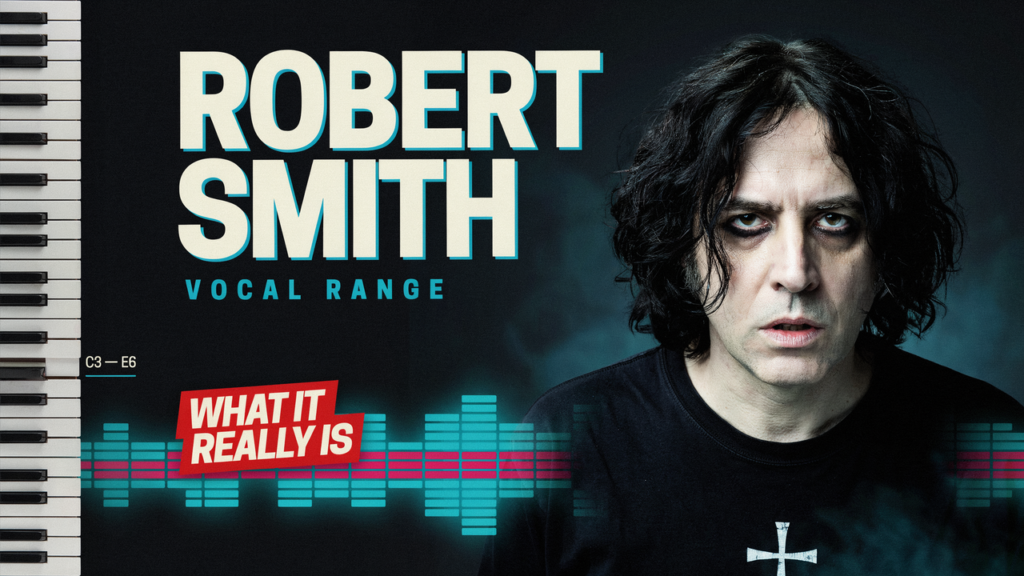
Understanding His Range in Context
Lowest and Highest Notes
Smith’s lower notes sit in the typical tenor zone. He doesn’t have a deep baritone bottom. His strength lies in his mid-to-upper range, where his tone becomes bright and expressive.
Here’s a simplified overview:
| Category | Approximate Range |
|---|---|
| Lowest Notes | Around B2 |
| Comfortable Range (Tessitura) | E3–E5 |
| Upper Head Voice | A5–B5 |
| Likely Voice Type | Tenor |
| Signature Quality | Light, airy upper tone |
If you compare this to the average male vocal range, his span is healthy but not extreme. The uniqueness comes from tone color and stylistic control.
Is Robert Smith a Tenor or Baritone?
This question comes up constantly.
Some listeners assume baritone because his tone can sound dark or mellow. But voice type isn’t about color. It’s about where the voice sits comfortably.
If you study the standard tenor vocal range, you’ll notice that Smith’s tessitura aligns more with tenor territory than baritone.
The key word here is tessitura. If you’re not familiar with it, understanding what tessitura means will clarify why classification isn’t based on one low or high note.
Tone color can mislead. Tessitura tells the truth.
How Robert Smith Uses His Registers
Smith is not a belter in the traditional rock sense. His strength is control, not volume.
Chest Voice
His chest voice is moderate in weight. It doesn’t have the thick, heavy density of dramatic rock tenors.
Head Voice and Light Mix
Where he stands out is in his upper mix and head voice.
He often approaches high notes lightly rather than forcefully. Think of it like floating the sound instead of throwing it.
If you’re still learning how registers function, review the difference between chest voice vs head voice before trying to imitate his upper tone.
Why His Voice Sounds Airy
Airiness doesn’t always mean weakness.
It often comes from:
- Slightly reduced cord compression
- Balanced breath flow
- Forward resonance placement
- Emotional stylistic choice
Imagine drawing with a pencil versus a marker. Both create lines. One is softer and more delicate.
Smith often chooses the “pencil” approach.
But here’s the important part: controlled airiness is different from breathiness caused by poor support.
If breath collapses, pitch stability disappears.
Use the note naming tool to track your ability over time.
Can You Sing in Robert Smith’s Range?
Before comparing yourself, measure your own voice accurately.
Use a structured method from this guide on how to find your vocal range so you know your true limits.
Guessing based on one high note doesn’t give reliable data.
Range is about repeatable, comfortable notes — not lucky attempts.
Step-by-Step: Developing a Light Upper Tenor Tone
If you want to sing in a similar style, focus on coordination first.
- Warm up gently in mid-range with humming.
- Slide upward slowly instead of jumping.
- Keep breath steady and consistent.
- Avoid pushing volume as you ascend.
- Stop immediately if the throat tightens.
High notes should feel narrow and forward, not wide and forced.
Building Stability First
Before chasing A5 or B5, make sure your E4–G4 range feels stable.
If your mid-range is shaky, the top won’t hold.
Develop consistent breath management with structured breathing techniques for singers before pushing higher.
Expanding Gradually
Upper range grows slowly.
If extension is your goal, follow a smart progression like the exercises in vocal exercises to increase range rather than forcing jumps.
If you’re unsure about your starting point, calculate it precisely using a vocal range calculator.
Common Mistakes When Trying to Copy His Style
Many singers misunderstand what makes his tone effective.
- Mistaking breathiness for stylistic airiness
- Neglecting support because the sound is soft
- Forcing chest voice higher than comfortable
- Ignoring warm-ups
- Comparing extreme notes instead of comfortable range
Soft singing still requires support.
Think of it like whispering across a large room. If airflow isn’t controlled, the message doesn’t carry.
Quick Self-Check
Ask yourself:
- Can I sing E4 comfortably without tension?
- Do my high notes feel light but stable?
- Can I sing softly without losing pitch?
- Does my voice recover quickly after practice?
If the answer is “no,” build coordination before trying to match his upper notes.
Sustainability matters more than height.
Realistic Expectations
Most male singers develop about 2 to 3 healthy octaves of usable range.
Smith’s range sits within that normal span. What makes him distinctive is control and stylistic consistency.
Trying to force airy high notes without stable breath support can cause fatigue. Soft does not mean effortless.
Your vocal folds are muscle tissue. They respond to gradual conditioning — not sudden demands.
If your goal is safe expansion, follow a structured progression like this guide on how to extend vocal range instead of pushing prematurely.
The Real Lesson From Robert Smith
His voice is not about volume.
It’s about mood.
He uses:
- Controlled dynamics
- Light upper resonance
- Emotional phrasing
- Consistent placement
Range alone doesn’t create impact.
Control does.
If you build coordination first, your range will expand naturally. If you chase height without stability, tension wins.
FAQs
1. What is Robert Smith’s vocal range in notes?
He spans roughly from B2 up to A5–B5 in head voice or light mix. His most comfortable singing range sits in the tenor tessitura.
2. How many octaves can Robert Smith sing?
Approximately 2.5 to 3 usable octaves depending on how upper head voice notes are counted.
3. Is Robert Smith a tenor or baritone?
He is generally considered a tenor because his tessitura and upper coordination align with tenor characteristics.
4. Does Robert Smith use falsetto?
He uses light head voice and mix, sometimes bordering on falsetto quality, especially for softer high notes.
5. Why does his voice sound airy?
His stylistic choice emphasizes lighter cord compression and forward resonance, creating a delicate texture.
6. Can I train to sing like Robert Smith?
You can develop a similar light upper tone with consistent technique and breath control. However, your anatomy will influence your final range.
7. Is his vocal range considered rare?
His range is healthy but not extreme. What stands out is tonal color and expressive delivery rather than unusually wide octave span.

Cooke is a vocal training and singing education writer specializing in vocal range analysis, pitch recognition, voice development, and singing tools for vocalists, performers, musicians, and beginners. He creates practical content focused on vocal improvement, singing techniques, and voice analysis resources.