
Kate Bush’s vocal range spans approximately D2 to C6 — about four octaves. Her voice type is a soprano with extraordinary range and one of the most experimental, theatrical approaches to singing in popular music. Bush uses her voice as a dramatic instrument, shifting between characters, registers, and tonal colours in ways few artists have attempted.
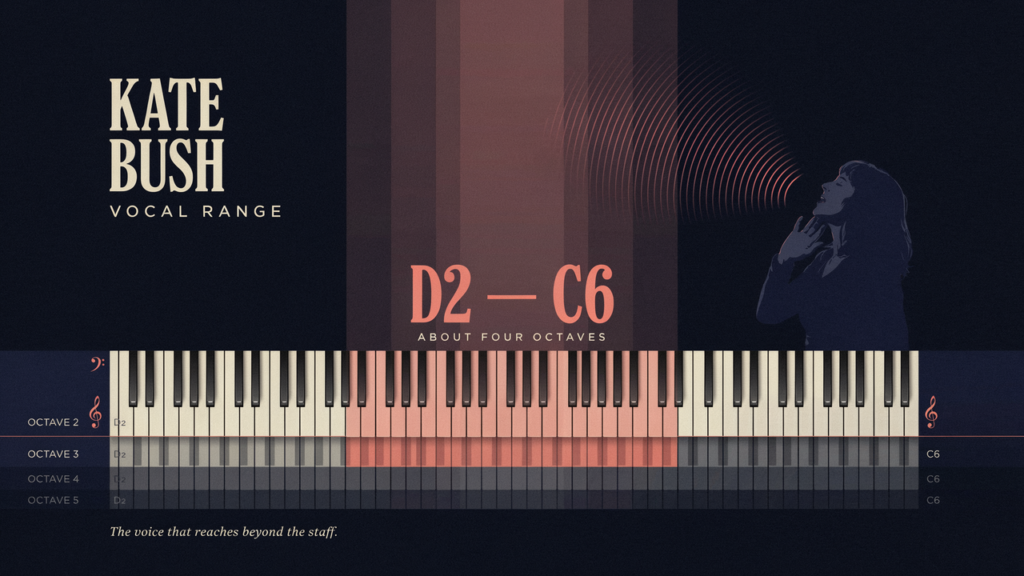
Kate Bush Vocal Range at a Glance
| Detail | Value |
|---|---|
| Full Range | D2–C6 |
| Span | ~4 octaves |
| Voice Type | Soprano |
| Lowest Note | D2 |
| Highest Note | C6 |
| Tessitura | A3–E5 |
| Known For | Theatrical delivery, experimental technique, wide range |
What Voice Type Is Kate Bush?
Kate Bush is a soprano with an unusually wide range and a deeply theatrical, experimental approach. While her natural classification is soprano, she accesses a surprisingly low register and deploys her voice in dramatic, character-driven ways that defy conventional categorisation.
Her artistry treats the voice as an expressive instrument capable of conveying narrative, character, and emotion through tonal shifts, register changes, and unconventional techniques. For more on the soprano classification, see the soprano vocal range guide and the female vocal range chart.
What Makes Kate Bush’s Voice Distinctive
Theatrical delivery. Bush approaches singing as dramatic performance, often adopting different vocal characters and personas within a single song or album.
Experimental technique. She uses unconventional vocal techniques — breathy textures, sudden register shifts, vocal sound effects — that expand the expressive vocabulary of pop singing.
Wide expressive range. From her high, soaring soprano to a surprisingly deep low register, Bush commands a wide tonal and dynamic range that serves her ambitious, conceptual songwriting.
Songs That Showcase Kate Bush’s Range
“Wuthering Heights” (1978) — Her breakthrough, showcasing her high, ethereal soprano and theatrical character delivery.
“Running Up That Hill” (1985) — Demonstrates her emotional control and the atmospheric power of her mid-range.
“Babooshka” (1980) — Highlights her dynamic shifts and character-driven vocal approach.
“Cloudbusting” (1985) — Shows her storytelling and the building emotional intensity of her delivery.
“This Woman’s Work” (1989) — A showcase of her upper register and emotional vulnerability.
How Kate Bush’s Range Compares to the Average Singer
The average singer has a range of about 1.5–2 octaves. Bush’s four-octave range places her among the widest in pop — in 4-octave vocal range territory. But her true distinction is her experimental, theatrical use of that range, which has influenced generations of art-pop and alternative vocalists.
Compare her range to other adventurous voices with the singer comparison tool, or explore the full list of famous singer vocal ranges.
Test Your Own Vocal Range
Curious how your range compares to Kate Bush’s? Take the free vocal range test to find your lowest and highest notes. To discover whether you share her soprano classification, use the voice type test. And to understand whether you have a rare four-octave reach, see our 4-octave vocal range guide.
Frequently Asked Questions
What is Kate Bush’s exact vocal range? Her range spans approximately D2 to C6 — about four octaves. Her tessitura sits between A3 and E5.
What voice type is Kate Bush? Kate Bush is a soprano with an unusually wide range and a theatrical, experimental approach to singing.
How many octaves can Kate Bush sing? Bush has a usable range of approximately four octaves, among the widest in pop music.
What makes Kate Bush’s voice unique? Her theatrical, character-driven delivery and experimental vocal techniques — combined with her wide range — make her one of the most distinctive and influential voices in art-pop.
Who has a voice influenced by Kate Bush? Many art-pop and alternative vocalists cite Bush as an influence, including artists who share her experimental, theatrical approach to singing.

Cooke is a vocal training and singing education writer specializing in vocal range analysis, pitch recognition, voice development, and singing tools for vocalists, performers, musicians, and beginners. He creates practical content focused on vocal improvement, singing techniques, and voice analysis resources.