
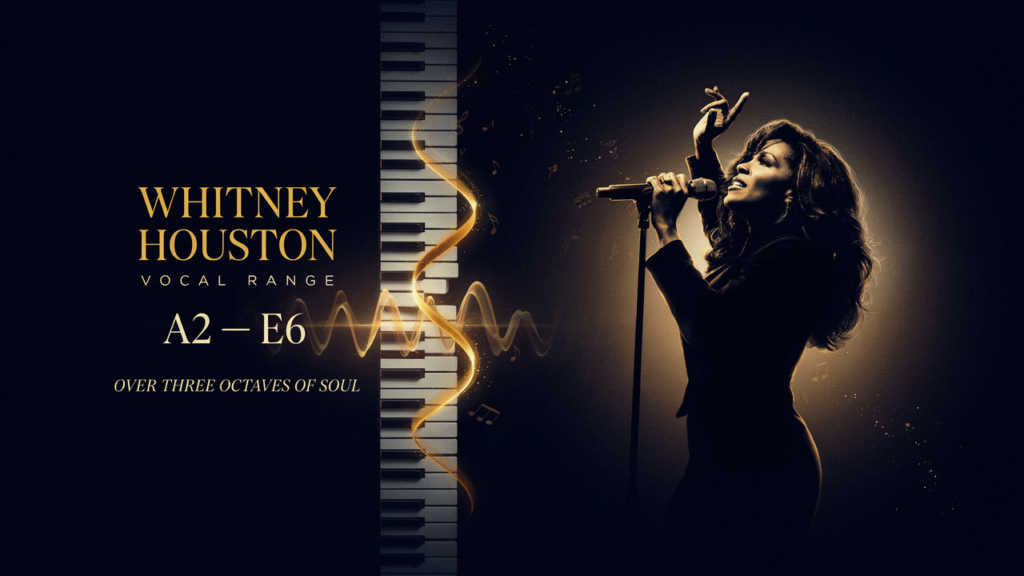
Whitney Houston’s vocal range is commonly cited as A2 to C6, just over three octaves (about 3.25). Her voice type is often described as a mezzo-soprano, although Wikipedia notes that she has also been called a soprano or a spinto soprano. Known as “the Voice”, Houston (1963 to 2012) mixed gospel-rooted phrasing with pop and R&B. Below you will find her highest and lowest notes by song, the octave arithmetic, and the sources behind each figure.
All figures on this page are estimates. No measured range has been published for Whitney Houston; the numbers come from the sheet music of her songs and from a range database that analyses recordings, and they differ by a few notes. Curious how your own voice compares? Find your own lowest and highest notes with our range test, then check them against the tables below.
- Try the Range Test
Sing your lowest and highest notes and see how many octaves you have.
- Which Voice Type Are You?
Mezzo-soprano, soprano, alto? Get a result from a few sung notes.
- Reach for Your Top Note
See how close you get to the F5 to C6 peaks in her songs.
Whitney Houston Vocal Range at a Glance
| Detail | Value |
|---|---|
| Estimated full range | A2–C6, commonly cited (39 semitones, about 3.25 octaves) |
| Other published estimate | A2–A♯5, about 3.1 octaves (Singing Carrots) |
| Voice type | Often described as a mezzo-soprano; also called a soprano or spinto soprano |
| Lowest note listed | A2 in “Where Do Broken Hearts Go” (Singing Carrots) |
| Highest note listed | C6 in “I Wanna Dance with Somebody (Who Loves Me)” (sheet music); B♭5 in “Run to You” (Singing Carrots) |
| Where her ballads sit | About F♯3 to F♯5 (six songs, table below) |
| Known for | Gospel-rooted phrasing, melisma, sustained ballad climaxes |
| Life | Born August 9, 1963, Newark, New Jersey; died February 11, 2012 |
Why do the numbers differ? Sheet music shows only what is written, while a range database counts every note it can find, including ad-libs. A2 to C6 is 39 semitones, or 3.25 octaves; A2 to A♯5 is 37 semitones, or 3.1 octaves. You may also see “A2–E6” or “four octaves” quoted. Neither is supported by the song-level sources checked: no listed song reaches E6 (A2 to E6 would be 3.6 octaves), and four octaves would take about 48 semitones, for example A2 to A6.
How Many Octaves Did Whitney Houston Sing?
Just over three octaves by the commonly cited A2 to C6, and about 3.1 by the Singing Carrots database. Wikipedia’s article says she had a four-octave range, but the note-level figures above do not reach four, so treat that number as a popular round-up rather than a measurement.
For context, an untrained adult can usually sing about two octaves (average singer’s range), so three octaves is well above typical. See what it means to have a three-octave singers range, and what a four-octave range would require by comparison.
What Voice Type Was Whitney Houston?
Whitney Houston is most often described as a mezzo-soprano, the middle female voice type. Wikipedia says her voice “has sometimes been described as either a soprano, spinto soprano or mezzo-soprano”, and Singing Carrots lists her songs as fitting both contralto (F3 to F5) and mezzo-soprano (A3 to A5) voices. There is no formal classification, so the label is a judgment about where her voice sat comfortably and how it sounded, not about her extreme notes.
The evidence from her songs: the ballads in the table below sit mostly between F♯3 and F♯5, close to the mezzo-soprano range commonly given as A3 to A5, with peaks that reach into soprano territory (G5 to C6) and low notes down to A2.
Was Whitney Houston a soprano?
Some sources call her a soprano or spinto soprano, and her peaks (B♭5, C6) are soprano-level notes. But peaks are not the test: the weight and centre of her songs sit lower, which is why mezzo-soprano is the most common description. For the typical soprano range and how the two differ, see alto or mezzo-soprano.
Was Whitney Houston an alto or contralto?
Not usually. Her lowest listed note (A2) is contralto-level, and the database says her songs are singable by contraltos, but no source checked classifies her as an alto or contralto. If you are unsure which of the lower female types you are, read mezzo-soprano and contralto or compare female voice types compared.
Whitney Houston’s Highest and Lowest Notes
These are notes documented in a named song, not guesses from live clips:
- C6, “I Wanna Dance with Somebody (Who Loves Me)”. The sheet music (quoted on Wikipedia) gives her line as A♭3 to C6; the song is in G♭ major and rises to A♭ major for the final choruses.
- B♭5, “Run to You”. The highest note Singing Carrots lists for her (the song spans A♭3 to B♭5).
- G5, “Where Do Broken Hearts Go”. The top of a song that also holds her lowest listed note.
- A2, “Where Do Broken Hearts Go”. The lowest note in the database (A2 to G5 for this song).
- F♯5, “I Have Nothing”. The sheet-music peak of one of her best-known ballads (G3 to F♯5); the same peak appears in “Saving All My Love for You” and “When You Believe”.
Two more anchors for her comfortable zone: “One Moment in Time” spans G3 to F5 and “Didn’t We Almost Have It All” spans B♭3 to E♭5 in the published sheet music.
Songs That Showcase Whitney Houston’s Range
Her best-known songs show different sides of the voice. “I Will Always Love You” (from The Bodyguard, written by Dolly Parton) is remembered for its key change before the final chorus. “I Have Nothing” and “Run to You” come from the same soundtrack. “Greatest Love of All” and “How Will I Know” come from her 1985 debut album, one a slow build and the other a bright pop song.
| Song | Vocal range | Source |
|---|---|---|
| I Wanna Dance with Somebody (Who Loves Me) | A♭3–C6 | Sheet music (Wikipedia) |
| I Have Nothing | G3–F♯5 | Sheet music (Wikipedia); same in Singing Carrots |
| Saving All My Love for You | F♯3–F♯5 | Sheet music (Wikipedia) |
| One Moment in Time | G3–F5 | Sheet music (Wikipedia) |
| Didn’t We Almost Have It All | B♭3–E♭5 | Sheet music (Wikipedia) |
| When You Believe (her part, with Mariah Carey) | F♯3–F♯5 | Sheet music (Wikipedia) |
| Where Do Broken Hearts Go | A2–G5 | Singing Carrots (lowest note listed) |
| Run to You | A♭3–B♭5 | Singing Carrots (highest note listed) |
To sing one of these in a more comfortable key, transpose her songs to your key first.
What Makes Whitney Houston’s Voice Distinctive
Gospel roots. Houston joined the choir at New Hope Baptist Church in Newark at the age of five, according to Wikipedia, and her mother, Cissy Houston, was also a singer. That background shows in her phrasing and dynamics.
Melisma. Critics often single out her melismatic runs, meaning several notes sung on one syllable, as a defining feature of her sound and a model for singers who followed.
Power and control. Reviewers praised the clarity of her tone and her sustained ballad climaxes. Belting and chest voice at this level is a coordination skill; see belting, chest voice and head voice for how the registers differ.
How Whitney Houston’s Range Compares to Other Singers
Her span of about three and a quarter octaves is well above the average, but her reputation also rests on control across that range. She recorded “When You Believe” with Mariah Carey, and you can compare their voices on Mariah Carey’s range. Another reference point is Celine Dion’s. To see many singers side by side, compare her with other famous singers.
Test Your Own Vocal Range
Want to know how your range compares? Take the range test on our homepage to find your lowest and highest notes, then use the voice type card above to see which voice type fits. To check your notes on a recording, get feedback on your take.
If you want to build stronger, more controlled high notes, start with the basics: strengthen your voice safely and grow your range step by step. Powerful singing is built slowly and should never hurt.
Whitney Houston Vocal Range FAQs
What was Whitney Houston’s vocal range?
Commonly cited as A2 to C6, about 3.25 octaves. The Singing Carrots database gives A2 to A♯5, about 3.1 octaves. Both are estimates.
What voice type was Whitney Houston?
Most often described as a mezzo-soprano. Wikipedia notes she has also been called a soprano or spinto soprano, and no formal classification exists.
How many octaves could Whitney Houston sing?
Just over three by the note-level sources. Wikipedia’s four-octave statement is not supported by the song ranges checked.
What was Whitney Houston’s highest note?
The highest note found in a named song is C6 in “I Wanna Dance with Somebody (Who Loves Me)”; the database lists B♭5 in “Run to You”.
What was her lowest note?
A2 in “Where Do Broken Hearts Go”, according to Singing Carrots.
Was Whitney Houston a soprano?
Some sources say so, but she is more often described as a mezzo-soprano because her songs sit lower in the voice.
Sources for These Figures
- Singing Carrots, Whitney Houston artist range page (A2–A♯5, 3.1 octaves; lowest song “Where Do Broken Hearts Go” A2–G5; highest “Run to You” A♭3–B♭5; voice types suited: contralto F3–F5, mezzo-soprano A3–A5).
- Wikipedia articles for “Whitney Houston” (voice descriptions, four-octave statement, early life, dates) and for “I Wanna Dance with Somebody (Who Loves Me)”, “I Have Nothing”, “Saving All My Love for You”, “One Moment in Time”, “Didn’t We Almost Have It All” and “When You Believe” (vocal range from sheet music).
- Octave arithmetic: semitones divided by 12.
A2–C6 is the commonly cited figure and matches the analysis sites listed in search results. Where sources disagree, this page shows the spread instead of one exact number.
Page last reviewed: .

Cooke is a vocal training and singing education writer specializing in vocal range analysis, pitch recognition, voice development, and singing tools for vocalists, performers, musicians, and beginners. He creates practical content focused on vocal improvement, singing techniques, and voice analysis resources.